Monday, February 04, 2008

A Visit to Oyamazumi-jinja.


The Ochis – Katsuhiko and Chiomi, and their sons Kazuma, Toshiki, and Ryota, every year make the drive north from Imabari to Innoshima on the Shimenami Kaido at mid-night, New Year’s Eve. Innoshima is the third, and largest of the series of seven islands running north across the Seto Sea from Imabari, Shikoku, to the main island of Honshu.

They do this to pay their respects to and lay the departing year to rest, and pray to the kami at Oyamazumi-jinja for good luck in the coming one. Oyamazumi-jinja is one of the most important shrines in Japan, a Samurai shrine and national treasure. A museum there houses an extremely important collection of Samurai armor, katana and other memorabilia.

They invited me along and of course I said yes!

It gets cold quickly in Imabari when the sun goes down in the winter, and there was a cutting wind blowing. It is often windy in the winter here. Katsuhiko picked me up at 11:45 outside my house, and we drove north on the Shimenami Kaido, a rare opportunity for me to see the bridge from a car! Usually I experience the bridge on a bike. It is four to six lanes wide, with separated, eight foot wide pedestrian/bicycle/scooter corridors on each side. The scooters use the east side corridors, and these are generally off limits to cyclists and pedestrians, so I cycle the west corridor. The bridge is very high in the first span and the views of the Seto Sea are impressive…but in the car, in the dark, it’s the scattered lights of the small villages on the islands that define the view for me…

The drive was quiet, the boys playing gameboys or sleeping, Chiomi watching tv on her keitei (!), Katsuhiko and I occasionally talking. I like driving at night like this, it is almost dreamlike, and the conversation seems to move freely from reminiscence to passing landmarks, to the weeks news.

We arrived and parked across the street from the Jinja entrance. Bundled up in my toque and cycling gloves and windproof goretex jacket, I still felt cold! I unfortunately had caught a cold a few days before.

We walked through the big entrance torii and past the guard dogs and the group of ten or twelve refreshment stalls selling hot tea, hotcakes, and skewered squid satay. The jinja is very big, and quite pretty. In the middle of the front square we stopped in front of a massive old tree, surrounded by a fence of stone donation markers. This is a Kusinoki (Camphor) tree said to be 2,600 years old! It is massive, though the top had been blown off sometime in the last 60 years or so, and it is only about 20 meters tall at the moment. This happens to old trees, and led me to wonder how many times it had happened to this one. It’s the oldest tree I’ve ever seen, I think. Later someone told me that among the giant Cedars of southern Kyushu there is one supposed to be 7,000 years old…astounding if true! Camphor trees are considered sacred and often grown at jinja.


I bought a 100 yen New Year’s prophesy at a stall in the inner courtyard, where the priests would be selling them and other amulets 24 hours a day for the next four days…and received highest good luck! Chiomi did too, so after the boys had written their new years goals on wooden amulets, we hurried off to hang them up at their designated spots for the Kami to take care of during the year. One ties ones paper fortune to a rope, or tree branch, being careful not to break it…or all is lost.

In the main shrine, it is possible to purchase more involved, lengthy purifications and ritual, though we did not investigate this.


Mission achieved, we walked around a little, where I saw another Camphor tree, perhaps a mere 800 years or so old…and I resolved to come back during the new year to visit the museum of armor, swords etc. Oyamazumi-jinja is the samurai shrine, the historic center of the samurai ethic, and the museum houses one of, if not the most, important collection of samurai armor and katana in Japan.

There were perhaps 1,000 people wandering around, by no means a large crowd, but I was told that by nine in the morning, cars would be backed up for a number of kilometers and one would not be able to walk freely because of the press of people within the grounds of the jinja. I was glad to see it at this, to me more special, time.

They treated me to a Japanese pancake, a hotcake cooked with anko, or red bean paste, in the middle. Hot and delicious! Around 2:15, we left, and drove back south. It was not the end of the trip, however, as we drove up Kiro-san on Oshima to the tenbodai, or viewing spot, to look at the lights of Imabari and Shikoku. The parking lot was dark and deserted. Kiro-san is a mountain on the southernmost island, Oshima, and the view is fabulous. The wind was fabulously cold, however, and after about two minutes admiring Imabari, (Oh, look, Ishizuchi Ski Field!) we hurried back down, and fired up the van’s heater. There is a small snack bar at the parking lot, and I'm told it is well known for its ice cream! I’ll try it in the summer…


I arrived back at my house at 3am, now prepared for the New Year. Thank you to the Ochi’s for a wonderful trip!

Thursday, February 15, 2007

Saijo Matsuri


Immediately after returning from the Iya Valley, I had the opportunity to go to the Saijo Matsuri festival. Saijo is a town about 50 km southeast of Imabari, known for its shipyards and temples. This Matsuri, held in the middle of October for four days, is one of the bigger ones around; this year there were 82 floats… The floats themselves are large…and very heavy, supposedly they can weigh, literally, a ton! They’re made of wood, gilt, cloth and many layers of paint. For all I know they have lead weights in them.


They are carried by six to ten men and women, and often have little children perched up in them, ten or twelve feet off the ground. The parade to the riverbed, which is wide, graveled, and flat, comes after everyone’s been up for four days drinking and carrying these things around the city…it’s a bit wild. I did not see any matsuri fall, but one or two came within a foot or so.


There was a camera crew from NHK (Japanese Television) there videotaping, and the matsuri had to be carried over the step of the covered cable…a number of crews didn’t really see the step or were too tired


to lift the float over them, and stumbled…we, of course, were standing right there, until one almost fell on my manager Mayu and myself…it was quite exciting.


This is one of the festival marshals, in what I thought was a rather natty outfit...for some reason, for me it recalls the way performance artist and activist Joseph Bueys might dress up for something like this...


When the floats get to the river, six cross the bridge to the west side and line up there. The others line up in two ranks on the east side. They display to each other, the bearers pumping the floats up and down vigorously…parading them around and generally causing a scene.


Eventually, after an hour or two of this, a parade of priests, notable guests and attendants crosses the bridge and make an agreement with the breakaway matsuri, and everything begins to settle down.


Meanwhile the food stalls are doing a brisk business as evening falls. That's Mayu and Chihiro on the right, with some green tea Pocky, I think.

Lanterns on the matsuri are lit.


The darkness seems to calm everyone down a bit...after a while everyone goes home, the gods are put back to sleep in their shrines, and that’s that for this year.

Wednesday, January 31, 2007

Chiiori


I had a few vacation days due me in October, so I resolved to visit the Iya Valley, and Chiiori. I had read about Chiiori, first in the Lonely Planet guide to Japan, and then in Alex Kerr’s ‘Lost Japan’, before coming here. Kerr’s description of this early Edo period (300 yr. old) farmhouse, perched in a small village on the side of a mountain, his exploits in buying and attempting to restore it seemed the stuff of legend. That there was a web page, www.chiiori.com, and I could go and stay there for a quite reasonable rate, made it a must see. With my still almost nonexistent Japanese abilities, it would be a challenge to get there.

I caught the train at Imabari Station, at nine am after losing my ticket (!) on the platform and missing the 8 am train I should have taken. Losing one’s ticket in Japan is a serious business, as it must be surrendered when exiting…so I just bought another one. The ticket agent that I tried to explain it to, (they’re starting to get to know me) just threw up her hands, and when I came back with my new ticket from the vending machine, had gone to the bathroom, probably to have a good laugh. Anyway I managed to catch a train, heading east. Off to a good start, I thought.


I had decided to take the local train east to Tadotsu, where I would have to switch and head south to Ikeda. I love riding the trains in Japan. They’re relatively cheap (cheaper than Canada, anyway), everyone rides them, they’re clean and quiet (mostly electric) and nearly always on time. And I’ve found JR staff to be friendly, helpful and understanding, unlike a few of my experiences with bus drivers. The ride east runs along the coastline, giving nice views north to the Seto Sea, and of farms and mountains and urban sprawl to the south.

In Tadotsu, I used some of my rudimentary Japanese to successfully change trains (I felt like a ten year old runaway). The local train I switched onto ran three stations and then stopped. Everyone got off, including me. It seemed I had to switch trains again, in order to get to Ikeda station. The train I had just left would turn east again just north of there and go to Tokushima. Unfortunately, the next train was not to arrive for some time. I was planning to take the city bus from Ikeda south to Oboke, and then east and into the Iya. Only two buses were running that I could catch however, and this train might make it impossible to take the 1:45, leaving me on the late bus, arriving at some mountain stop in the dark around 5:30…

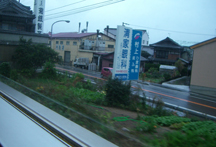
I shot a photo of the peculiar roof ornamentation on the station itself. I had no idea what the character meant; later however, at New Years, I ended up back in Kotohira, for that’s where I was, and found that symbol to be the kanji for Kompira-san.

One of the other cool things about JR is that one can almost always change one’s ticket at any station. Seeing that there was a semi-express coming through in a half hour, which would go to Ikeda, and might allow me to take the early bus, I paid and upgraded my ticket. Yahoo! When I arrived in Ikeda, I walked down the street to the bus station…and found I’d missed the early bus by eight minutes. Oh well. I phoned Chiiori to tell them I would be on the late bus, and got some weird American guy who was quite excited and adament that I not try to walk in from the highway in the dark. I bought a ticket for the 4:30 bus and got a bento at the nearest supa, where I was also able to get a flashlight and stock up on cheap chocolate, and had lunch.

The bus ride south to Oboke and east was wonderful: the river turns into a gorge, the mountains become outrageously steep and the road outrageously narrow. I’ve seen some narrow roads in British Columbia, and this one matched, and then exceeded them. After an hour of winding curves with amazing views, anxiously counting tunnels and such, I found that my fare was matched on the electronic meter above the front window. Eureka! I pulled the cord and jumped off, thanking the driver.


I walked back over the bridge and stood at the corner. It was growing dark. Tim, an amiable Tazmanian volunteer, pulled up in a van. We drove up into the gathering dark to Chiiori.

James, the supervisor, and Laurie, a second volunteer were just starting dinner. We ate around the irori, or interior firepit, and then lounged about drinking homegrown tea, chatting and reading. I found it amazing that this was the only source of heat in this large space, in a place where the temperature is below zero for four months of the year! I come from near Ottawa, Canada, and the winters are cold there. But I can’t imagine wintering in a space with only this as the heat source. Must have been bloody cold.


This was the norm in the evenings. It suited me very well, and I found myself relaxing, though I definitely wanted more, perhaps a couple of weeks…

I had not spent any time in a space like this before; the ceiling is open and perhaps 25 feet from the floor at the apex, the shoji and fusumi create a modular space which is always changing, yet with simple boundaries. The floorboards are polished black with many years of soot and feet. And of course the windows open up into a spectacular, very steep drop four or five hundred feet to the valley bottom...the space opens up almost as if I were in a large, wooden cave...


This is the view out the front door.

One of my (many) bad habits is being overly helpful. Everyone tolerated this remarkably well, and even eventually gave me some small, not-potentially-damaging tasks to accomplish.


Otherwise I loafed about for three days, spending one afternoon down at the swimming hole, where I photographed some leaves, and saw, for the first time, an actual deer wallow! We heard these deer occasionally, and saw one. They have a strange screaming rutting call.

This photo shows a terrace, constructed who knows when, but replanted in cedar in the early seventies by local farmers on a federal program. The price of cedar has since plummeted due to overplanting, making these trees economically worthless to the farmers. One of the oddest sights, to me, is to be walking through forest, even if it's only forty years old, and see these freestone walls, which could be 3, 4 or 500 years old, scattered through the woods...it's very strange.


I found the leaves in the water beautiful and shot some.


I also explored the neighborhood a bit on foot. We saw a few abandoned farmhouses, something I encountered a few weeks later as well below Ishizuchi-san.


There is also a very nice shrine right across the road from the house, with some very large cedar trees, the largest of which, cut down, was five feet across at the base. I felt briefly like I was back in BC!


We spent one day being chauffered by Tim to the local museum, the vine bridges, which have been rebuilt in the same locations for 800 years, and eventually to Tsurugi-san, which we were able to climb.


On the day I left I opted to walk the two or three kilometers out to the highway, and it was a wonderful little mini-hike. I caught the bus back and made it home by 6:30 pm with about 500 en ($5) in my pocket. Not bad!


I found Chiori a stunning place, very special and well worth the trip, and I hope to go back sometime soon…

Tuesday, November 21, 2006


Ishizuchi-san’s Beech Forest

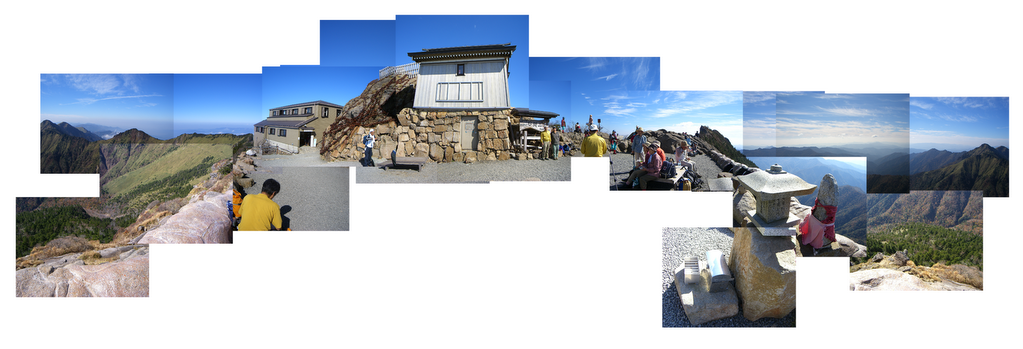
Ishizuchi-san is Shikoku’s highest and most famous holy mountain. Pilgrims and tourists of all sorts have been climbing it for 1300 years. I am partial to mountains, and was able to take a walk up the hill on October 30th. I left Imabari on the 6:07 am local train to Iyo-Saijo. The bus to Ishizuchi-san leaves from Iyo-Saijo, but only runs 4 times daily; I took the 7:43 to the ropeway. There is a trail that runs up the mountain starting half a km. past the ropeway, but it's steep, and might add 2.5 hours to the hike. I wasn’t sure I could catch the 3:17 return bus, so I took the ropeway. It was scenic and fast, traversing almost 3000 feet of elevation in what seemed like a few minutes. The hill was dotted with red and yellow colour; Autumn, my favorite season, was here.


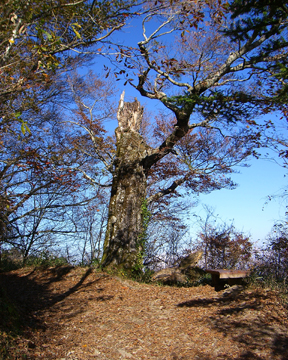
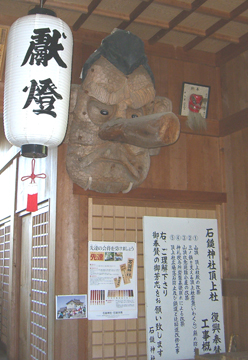
The path winds up to some refreshment shops and Jojusha, a large and impressive shrine. A wonderful mask there looks like Richard Nixon with a very long nose. Turning left through a torii, the path to Ishizuchi-san runs along a ridge through the forest. I immediately noticed the Beech trees, and found Sassafras leaves on the path. I know Sassafras only through leaves I have studied from 42 million year old Eocene fossils in Kamloops, BC. I started to look around me more carefully and soon realized that I was in a very special kind of forest with a broad range of trees, bushes and plants. The understory of Sasu, dwarf bamboo, is specific to this ecosystem, as is a rare form of aralia. I thought I saw Fir trees, some kind of Yew, and Arbutus, which I only know from a small area right around Vancouver. I saw Japanese maple, Cedar, a Birch tree and what I thought must be Alder. I found a leaf which seemed like it came from a Viburnum. I found out later that this is called Taiheiyo Montaine Deciduous Forest. It seemed a very special place, and quite beautiful. But pressing on, the hill steepened.


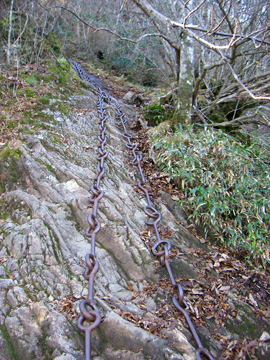
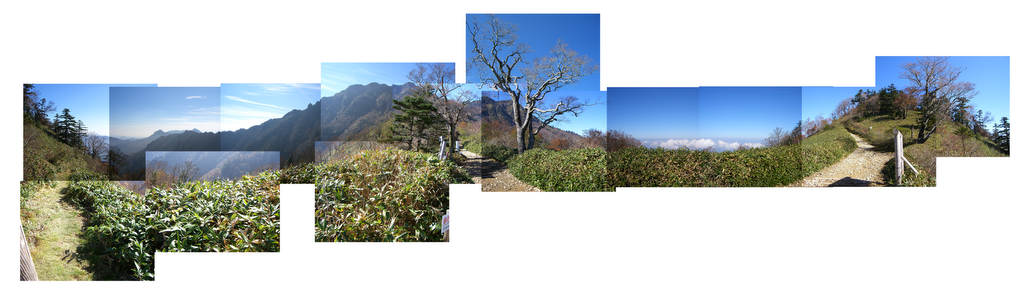
I came to the first set of chains, and, in a fit of machismo, climbed them. When I came to the top I walked over the little peak, and found more chains dropping eighty feet over a nasty rock face to the path. I chickened out and went back down the first set, and stayed away from the chains from then on. The trail now climbed more steeply to a second ridge, where it came out into the open, and I could see the mountains to the south and east clearly for the first time… a stunning view!


Through a second torii and up the final face, steep again, eventually coming to the peak of Mizan. Here there is a small Shinto shrine and a ryokan, at almost 6,000 feet elevation! The day was sunny, and the view spectacular. I decided to scramble over to Tengu-Dake, a ten minute hike along a razorback ridge. As I scrambled over one section of tilted rock, nothing to my left but blue sky and clouds, and nothing to my right except steeply tilted rock, blue sky and clouds, I gained a lot of respect for those who had come before me!


From Mizan I could see paths descending to the south, and along the mountain ridges to the east and west. On the way back down, I struck up a conversation with a man who runs a business selling watches. He likes to climb mountains and hikes to stay in shape. He told me he had come up the mountain by a different route, early that morning. I hoped to walk down the trail to the bus stop rather than take the ropeway if I had time. We were almost there when I saw a small path leading off to the right. A sign on it said Nishinokawa. He said: “your route”. I shook his hand and went down the path.


The trail was narrow and very steep. As I walked fast through the cedar plantation, I could hear repeated chanting in the valley below me. I stopped to listen to it echo faintly through the woods, and recorded it. The last kilometer of the trail was on a network of village paths, winding past three abandoned houses and eventually through a small village, mostly, it seemed, abandoned as well. This was interesting but it made me melancholy to see so much labor, so much knowledge, abandoned. I came out on the road about a half km up the valley from the ropeway. In a parking place stood about twenty five young Japanese men and women in white yukata and headbands. Two middle aged men were talking to them. Whatever the ceremony, it had ended. I headed down the road.


I missed my bus by nine minutes. Ah, well. I spent the next two hours drying off (I was soaked with sweat) as the afternoon turned chilly. The last bus arrived just after five. The bus driver was the same older gentleman who was driving in the morning. He motioned me over, and told me I could get in…In my very bad, very basic Japanese I told him I was going to Saijo, and pointed back down the road from where he’d just come. He laughed and repeated that I should get in. So I said thanks!, grabbed my pack and found a seat. He drove up the road to where the trail came out and turned the bus. We waited there ten minutes, during which time he swept around the bus shelter with a rough straw broom. Just as he was firing up our bus to leave, three busloads of the mysterious practitioners swept by, on their way home at last.

I shouldn’t have taken the trail down; I could hardly walk for the next four days.

Thursday, November 16, 2006

The Cooking Club


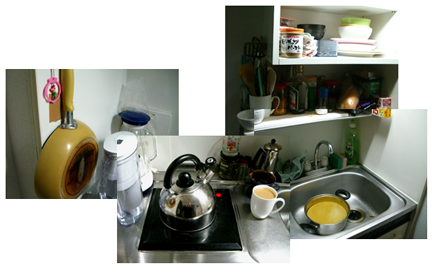
I have been living in Imabari for about five months now, since the end of May, 2006. My company placed my lodgings in an apato called Leopalace21. In its favour, it is clean, modern and has air conditioning. It’s also about a third the size of my last one bedroom apartment in Vancouver. It was designed for itinerent twenty-somethings, who never cook anything more than a cup of coffee. The kitchen is an alcove with a one burner hotplate in it. There is a special closet with room for eight pairs of shoes in it, but nowhere to put canned goods. It’s ok, though, I can cook on one burner.
There’s lots of cheap, great tasting Japanese food available takeout and in every Lawsons, Circle K, or in my local 24 hour shop, Lifeshop, so adjusting to eating in Japan is pretty easy. But I always like to be able to cook. Amidst all my complaining and research and so on, I mentioned to Mayu, my manager, and Chihiro and Michico, my two Japanese colleagues at the school, that it might be fun to start a cooking club. To my surprise, they jumped at it.


First meeting
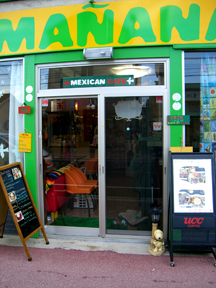
We held a first meeting at a small restaurant called ‘Manana’ which had recently opened near GEOS Kodomo. It’s run by a young woman recently returned from the west coast of America, where she lived for three years. While there she developed a liking for Mexican food, and has brought it back to Imabari to add to the mix. Kudos!

We had a nice meeting, where I presented a cobbled together Avocado salad, approximated from a description of one at an Indian restaurant in New York City. I uncovered this recipe while searching for Indian food suppliers on the web. I found a great company in Japan called Indo-Jin, www.indo-jin.com, from which I can order online and receive stuff in four or five days! Very cool. My thanks to the gourmet bloggers, who must remain anonymous because I managed to lose their url and name, for a wonderful blog.

The salad was very good, I thought, with highlights of roasted cumin and lemon. Yum. The meeting was also good, and we agreed to meet again.

Second Meeting
The women suggested that our next meeting be at Michico’s house. Michico lives at home in a region called Sakurai, in the southern part of Imabari proper. Chihiro picked up Mayu and me and drove us there in her very efficient, boxy little van. It’s got some cute little name like ‘Cuby’ or something. I don’t think any one reads these names.

Sakurai is country-ish, with a lot more greenery than downtown. Michico lives right down near the beach. There are dirt roads and driveways. I’m beginning to find this sort of thing refreshing, the more concrete I see. It sometimes seems every road in japan is paved or concreted over. I’ve been down roads that were 10 feet wide, hadn’t seen a vehicle in months, maybe a year, and were concrete. It’s a bit weird. I come from British Columbia, and 16 years of treeplanting, and have seen a lot of logging roads! Next to none of them were paved…


Anyway, I find that there’s a kind of appeal in ‘brown’ lands, lands on the periphery of human interest, the verges of highways, abandoned fields and factories, railway lands, and so on. Michico’s neighborhood has this kind of interest for me. Her dad is a well known stone sculptor, and half their property is taken up with his factory-like, sheet metal, production studio.

There are lots (20+) of wild stone sculptures at the front of the house, some of Buddhist deities. Her house is interesting; on the exterior it looks like an amalgam of western and Japanese influences, it seems to me. Inside, it’s laid out with a combination of shoji and western style walls. The dining room had a western style dining table and chair set, and a lot of Japanese and western clutter. The kitchen was, surprise!, fairly large and well laid out, with lots of cupboard space. Yowsers! This was the first Japanese kitchen I’d been in and it reassured me that not everyone cooked on single burner stoves in alcoves…thank goodness.

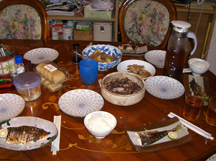
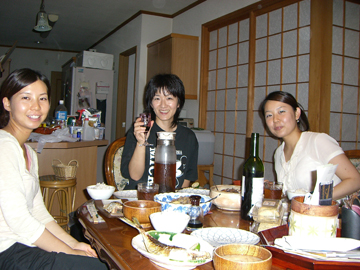
The women had decided on a menu of traditional Japanese dishes: Nikujaga, a kind of beef and potato stew, a squid dish called Ika no Nimono, a pork dish called Buta no Shoga Yaki, Yaki Zakana (grilled fish), Miso Shiru (Miso soup), and of course rice. My contribution was a bottle of cabernet sauvignon I’d won bowling. Michico’s sister, Mariko, joined us with a lovely cake.

Michico was lead cook, Mayu and Chihiro assisting. I was chief potato peeler and stayer out of the way. Of course I got in the way, taking pics with my shiny new Casio exs-600. For a point and shoot, it’s a very nice little camera. Of course, I wish I could afford a Nikon d20 or something of the sort, but those large cameras, as well as being out of my budget range, are hard to carry around. They sort of demand that one become a ‘PHOTOGRAPHER’, which is not my aim. So the little exs600 works quite well for me; I throw it in my pack and bash it around all over the place, and it takes, by and large, quite credible pictures. Of course I found out two days after I bought it that I could have gotten the ‘pro’ version of the same camera, presumably with better manual controls, for a little more…I decided not to bother.


By now dinner was cooked, the table set, and all of us starving. Dinner was delicious, a great success. We agreed to meet again, but did not set a date.